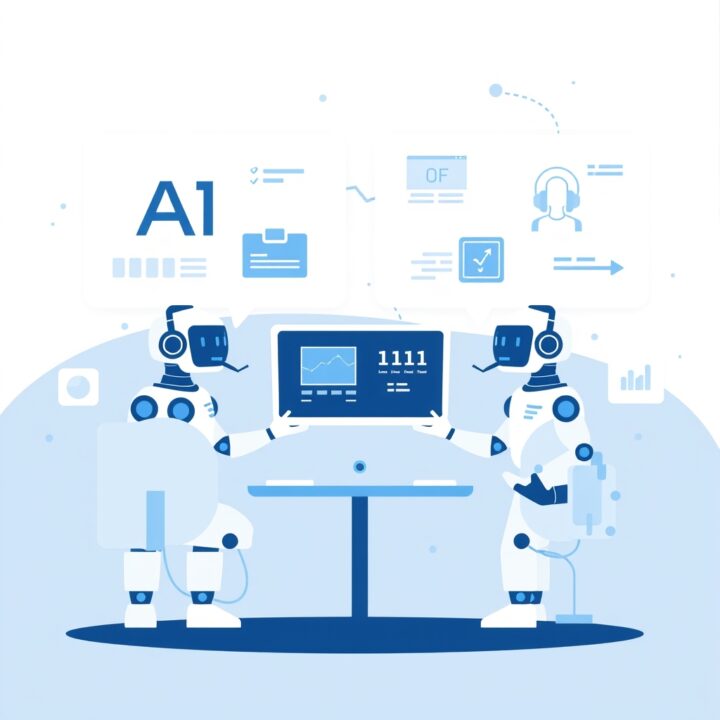
AI agents for customer support automation are changing how companies handle high ticket volumes, slow response times, and agent burnout. If you run a SaaS product, an e-commerce platform, or a B2B service, you already know the problem. Customers expect answers in minutes, not hours. However, scaling a human support team is expensive and slow. AI agents solve this without sacrificing quality.
What AI Agents for Customer Support Automation Actually Do
An AI agent is not a simple chatbot. It is an autonomous system that perceives context, reasons through it, and takes action. In customer support, that means the agent reads an incoming ticket, classifies its intent, decides who should handle it, and drafts a response—all without human intervention.
For example, a billing dispute gets routed to the finance queue automatically. A password reset request gets resolved instantly. A complex technical complaint gets escalated with a concise summary already attached. As a result, your human agents spend time only on work that truly requires judgment.
The Three Core Functions: Routing, Summarization, and Response Drafting
Every mature AI agent for support covers three workflows. First, routing classifies incoming messages by intent, urgency, and customer tier. Models fine-tuned on your historical tickets reach 85–95% routing accuracy within weeks of deployment.
Second, summarization compresses a long conversation thread into two or three sentences. This saves agents three to five minutes per ticket on average. At 500 tickets a day, that is roughly 40 hours of saved labor daily.
Third, response drafting generates a contextually accurate reply using your knowledge base, past resolutions, and tone guidelines. The agent presents a draft; the human approves or edits it. Therefore, quality stays high while speed increases dramatically.
How the End-to-End Pipeline Works
Understanding the full pipeline helps you evaluate what you actually need to build. The flow looks like this: ingest → classify → retrieve → generate → review → send.
A ticket arrives via email, chat, or API. The agent classifies it using a fine-tuned language model. It then retrieves relevant context from your CRM, help docs, or order management system. Next, it generates a response draft grounded in that retrieved data. Finally, a human agent reviews and sends it—or the system sends it autonomously for low-risk categories like order status updates.
Retrieval-Augmented Generation Is the Key Technical Component
Most production AI agents for customer support automation use Retrieval-Augmented Generation, or RAG. Instead of relying on a model’s training data alone, RAG pulls live context from your internal knowledge base before generating a response. This keeps answers accurate and specific to your product.
In addition, RAG reduces hallucination risk significantly. Without it, a model might invent a refund policy that does not exist. With it, the model cites your actual policy document. The difference matters enormously in regulated industries like fintech or healthcare.
What It Takes to Integrate an AI Agent into Existing Software
Integration is where most projects either succeed or stall. The agent needs clean access to your ticketing system, your CRM, and your knowledge base. That usually means building or consuming REST APIs. However, legacy systems often lack modern APIs, which adds scoping complexity upfront.
You also need a human-in-the-loop layer for the first three to six months. This is not optional. It is how you collect correction data, improve routing accuracy, and build stakeholder confidence. Skipping this step leads to poor performance and lost trust.
Data Requirements and Model Selection
You need at minimum 2,000 to 5,000 labeled historical tickets to fine-tune a routing classifier worth deploying. For response drafting, a strong base model like GPT-4o or Claude 3.5 Sonnet combined with RAG typically outperforms a custom-trained model—and costs far less to maintain.
Model selection depends on your latency requirements, data privacy constraints, and budget. For example, a company handling sensitive customer data may prefer a self-hosted open-source model like Llama 3 over a cloud API. Therefore, architecture decisions must happen before a single line of code is written.
Real Tradeoffs You Should Know Before You Build
AI agents improve with volume. A small support operation with under 100 tickets per day may see limited ROI in the first quarter. However, at 500 or more tickets per day, the economics become very compelling very quickly.
Maintenance is a real ongoing cost. Models drift as your product changes. You need a process to update your knowledge base, retrain classifiers periodically, and monitor response quality. In addition, you need guardrails to prevent the agent from making commitments your business cannot keep.
Build vs. Buy: The Honest Comparison
Off-the-shelf tools like Intercom Fin or Zendesk AI work well for standard use cases. However, they break down when your support workflows are complex, your product is niche, or you need deep integration with proprietary internal systems.
Custom development gives you full control over routing logic, tone, escalation rules, and data ownership. It also allows the agent to take actions—not just respond—such as issuing refunds, updating account records, or triggering workflows in your backend. That level of capability requires purpose-built software.
How Akshu Soft Tech Approaches This Build
We treat AI agent projects as software engineering problems first and AI problems second. That means starting with a thorough audit of your existing data, APIs, and support workflows before selecting any model or framework. Most teams underestimate this discovery phase, and it is where most failed AI projects go wrong.
Our team builds the full stack: data pipelines, RAG architecture, classifier fine-tuning, API integrations, and the human-review interface. We also help you define the metrics that matter—containment rate, first-response time, CSAT impact—so you can measure ROI clearly from day one. If you want to see how this fits into a broader product strategy, explore our custom software development services to understand how we scope and deliver complex builds end to end.
Is Now the Right Time to Deploy AI Agents for Customer Support Automation?
If you handle more than 300 support tickets per day and your team spends significant time on repetitive, low-complexity requests, the answer is almost certainly yes. The technology is mature. The tooling is proven. The ROI is measurable.
However, success depends entirely on implementation quality. A poorly integrated AI agent creates more problems than it solves. Therefore, choose a development partner who understands both the AI layer and the software engineering rigor required to make it reliable in production. That combination is rarer than most vendors will admit.